Warmth isn’t only visual; it’s acoustic, too
Warmth is often treated as a visual quality – timber tones, soft lighting, natural textures, a calm palette. But architectural acoustics is what often defines the most ‘warm’ spaces, shaped just as much by what you don’t hear: the harsh ring of voices, the brittle clatter of movement, the fatigue that builds when a room won’t settle.
A space can look beautifully composed and still feel uncomfortable. Often, the difference is acoustic.
When architects talk about atmosphere, they’re describing something holistic: how a room holds people, how it supports conversation, focus, learning, performance, rest. Architectural acoustics is one of the few design layers that directly shapes all of those behaviours – and it can do it without announcing itself.
When a room looks calm but sounds hard
Many contemporary interiors lean into clean lines and crisp surfaces: exposed soffits, glass, stone, terrazzo, polished plaster – with timber used as an accent rather than a softening layer. Visually, it can be striking. Acoustically, it can be unforgiving.
In overly reflective rooms, sound lingers. Speech loses clarity. Reverberation builds. Background noise accumulates. The space becomes subtly tiring, not because anything is ‘wrong’, but because the room never stops talking back.
That’s why acoustics works best when it’s considered as part of the atmosphere brief, not a late-stage compliance fix.
Acoustic performance that doesn’t ‘look acoustic’
The goal isn’t to add visible treatment. It’s to integrate absorption into the architecture so the finish stays clean and intentional.
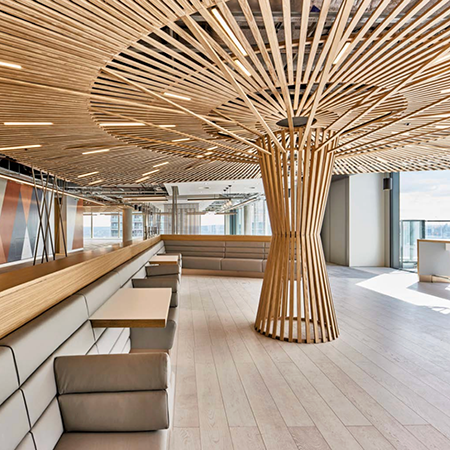
Timber acoustic panels are particularly effective here: they bring material warmth, while the acoustic layer sits quietly within the surface. Used on ceilings and walls, they can reduce reverberation and support speech intelligibility without disrupting the material story. Depending on the visual language of the space, this might mean:
– Micro-perforation for a calm, near-invisible acoustic surface
– Linear slots/slats for a controlled rhythm that doubles as absorption
Both can be detailed to align with lighting, grids and service zones so the ceiling reads as design, not correction.
Bring acoustics in early
If you bring acoustics into the conversation at concept stage, you keep far more freedom: fewer compromises, cleaner details and a more coherent material story.
Share a sketch plan/section and room type, and we’ll recommend suitable timber build-ups (including guidance on absorption approach, build-up depth and finish intent) and provide the supporting data to help you specify with confidence.
Talk to the technical team
Architectural Acoustics: Warmth You Can Hear

| T | 01227 913671 |
|---|---|
| E | enquiries@acoustic-products.co.uk |
| W | Visit Acoustic Products's website |
| 70C High Street, Whitstable, Kent, CT5 1BB |
Products by this Company