Can You Omit a Local MCB for SPDs in Domestic Installations?
A Practical Guide for Installers
When it comes to surge protection devices (SPDs), one question keeps coming up on site:
“Can I connect an SPD directly to the busbar and rely on the DNO fuse?”
This guide cuts through the noise and gives you a clear, standards-backed answer, so you can make the right call quickly and confidently.
The Short Answer
Yes, but only under strict conditions.
In residential installations, you can omit a local MCB/fuse for an SPD only if all of the following are met:
The installation is domestic (household or similar)
The SPD complies with BS EN / IEC 61643-11
The manufacturer explicitly allows omission of local overcurrent protection
The upstream DNO fuse is ≤125A
If any of these conditions are not met, you must use a local OCPD.
Why This Works (When Done Correctly)
This approach is based on recognised industry guidance and two key engineering principles:
1. Controlled Failure Mode (Designed to Fail Safe)
SPDs are sacrificial devices, they degrade over time due to surges.
They can fail in two ways:
Open circuit (preferred)
Device isolates safely
Indicator shows replacement needed
No loss of power to the installation
Short circuit (undesired, rare)
Fault path created
DNO fuse may operate → full board outage
Lewden SPDs are engineered so that open circuit failure is overwhelmingly the outcome, minimising disruption.
2. Short-Circuit Withstand Capability
A key requirement is ensuring the SPD can handle fault conditions safely.
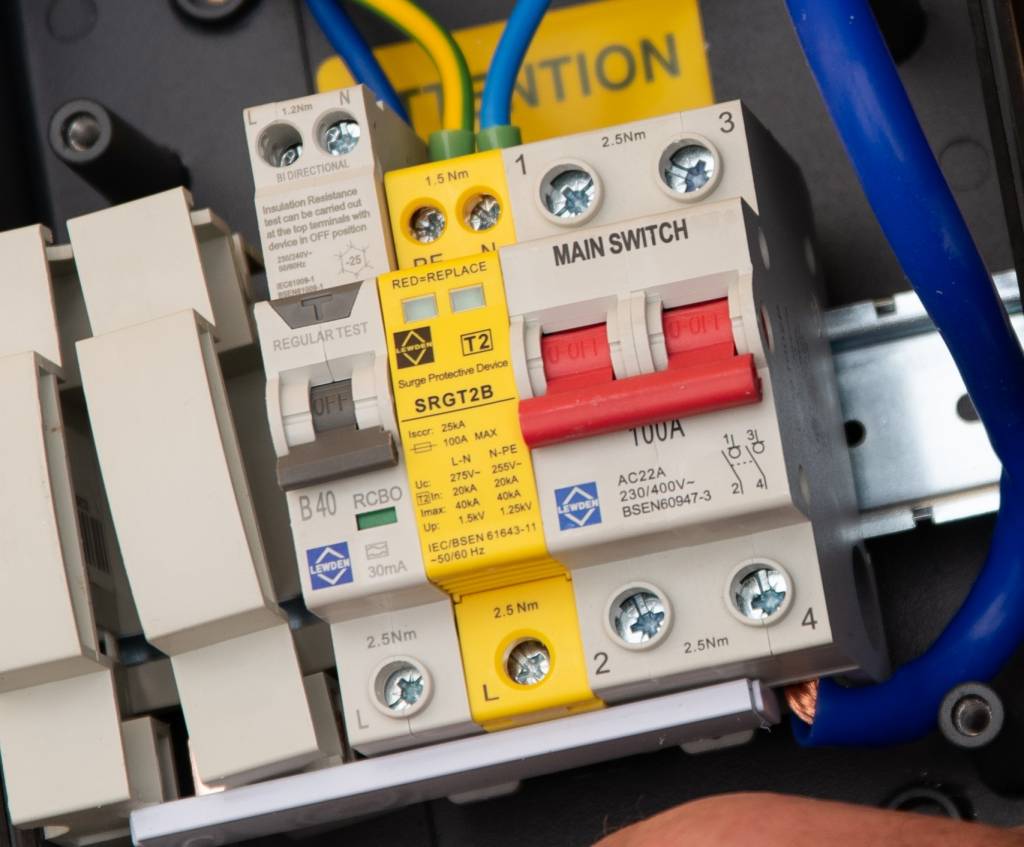
Lewden SRGT2B has a short-circuit rating of 25kA
Typical domestic installations have a maximum prospective fault current of ~16kA
Result:
The SPD can withstand fault conditions without damage, allowing protective devices to operate correctly.
Why Older Designs Used a Dedicated MCB
Previously, SPDs were installed with a dedicated MCB (OPCD2) to:
Provide short-circuit protection
Enable busbar connection
Allow isolation for maintenance
Ensure selectivity with the DNO fuse
However, this introduced a limitation:
High surge currents (e.g. 20kA) could damage a 6kA MCB, restricting SPD performance
Lewden’s Design Approach
Lewden’s current SPD design (SRGT2B) is built around this guidance:
Direct busbar connection capability
No dedicated MCB required (when conditions are met)
25kA short-circuit withstand rating
Designed for ≤100A upstream protection (typical DNO fuse)
Plug-in cartridge for quick replacement
Visual and remote end-of-life indication
Just as important:
Extensive testing shows short-circuit failure is very rare
This reduces the likelihood of DNO fuse operation and total outage
Where You CANNOT Use This Approach
Do not rely on the DNO fuse alone in:
Commercial or industrial installations
3-phase systems
Installations with higher fault levels (up to 100kA)
Any SPD where the manufacturer does not permit omission of local protection
In these cases, local OCPD is mandatory.
Quick Installer Checklist
Before omitting the MCB, ask:
✔ Is this a domestic installation?
✔ Is the SPD compliant with BS EN / IEC 61643-11?
✔ Do the manufacturer’s instructions allow omission?
✔ Is the upstream fuse ≤125A?
If the answer is YES to all → you’re good to proceed.
Learn more
Can You Omit a Local MCB for SPDs?

| T | +44 (0)1376 336200 |
|---|---|
| E | sales@lewden.co.uk |
| W | Visit Lewden Ltd's website |
| 4, Springwood Industrial Estate, Bradbury Dr, Braintree, CM7 2SD |