
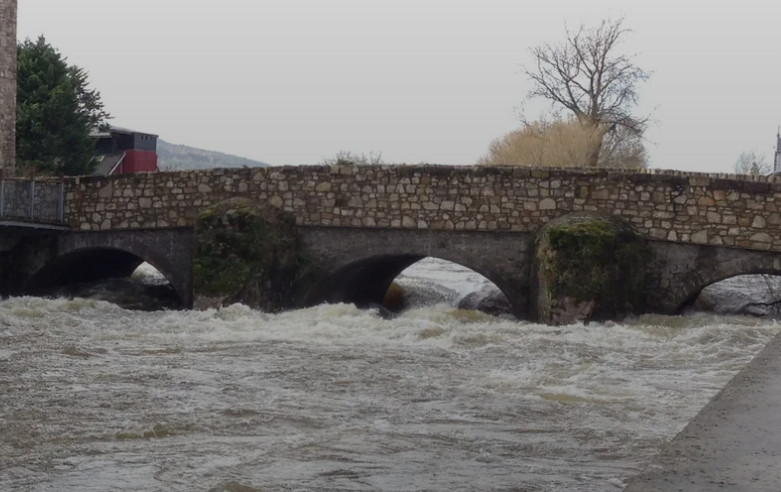
Between 1995 & 2009, Clonmel Town suffered severe flooding on a regular basis from the River Suir and its tributaries.
Rubber duckbill valves made a crucial contribution to the design & construction of this important and complex flood defence scheme, which was shortlisted for the 2012 Engineering Project of the Year by Engineers Ireland. The scheme, and the valves, performed admirably during the major floods over the 2015/2016 Christmas period, considered its first significant flood test.
Records show that the quays in the town flooded on average six out of every ten years, with most severe flooding in Clonmel occurring in 1995, 1996, 1997 and 2000, 2004, 2008 and twice in 2009, all of which had a severe impact on the town's population, commerce and infrastructure.
A Steering Group, consisting of the OPW, South Tipperary County Council, Clonmel Borough Council and Waterford County Council, was formed to oversee the process of developing and implementing a flood relief scheme that was economically viable and environmentally acceptable. Mott MacDonald Ireland, were appointed in 2003 to carry out the design, which would offer protection in a standard 100 year flood event but could be adapted in the future to accommodate a 20% increase in design flow due to climate change.
Out of all the options considered, providing a fully defended urban area using hard engineered defences to contain the flood water within the river channel was chosen as the most cost effective and reliable way to manage the flood risk. Hydraulic modelling indicated that with design flood levels estimated at 2.5m O.D. the channel would require walls 2.8m high.
In order to mitigate the negative effects on the town and its residents of such high walls, it was decided to design for a removable wall on top of a permanent wall of standard 1.2m height along the river quays. This effectively meant that the river would be above street level during flood events, and so non-return valves on the outfalls would form a key component of the design, preventing flood waters from pushing upstream through road gullies, manhole covers, back inlet gulley traps, etc. In order to prevent stormwater backing up in the drainage system, 12 pump stations were required at strategic locations to over pump to the river.
The works, which were divided into three schemes, commenced in 2007 and were substantially complete in 2012. At the time, it was considered that the effectiveness of the scheme depended on the timely erection of the demountable defences and, while that is still certainly the case, an incident in 2014 provided proof that the drainage outfalls into the river play a crucial part in this scheme, particularly the non-return valves on the outfalls.
River outfalls can be notoriously problematic, being prone to debris accumulation, siltation and exposure to fast flowing waters. And particularly in this scheme it was important to ensure that there would be no blockages during normal function and, conversely, reliable and total exclusion of water ingress during flood conditions.
Rubber duckbill valves were recognised by the design team as the most reliable, maintenance-free drainage check valves on the market today for these types of conditions, and 6 large rubber duckbill valves were chosen for the outfalls located in areas that are harder to access and most prone to silt and debris.
Learn more
Clonmel Flood Defence Scheme

| T | 01513240021 |
|---|---|
| E | info@measurit.com |
| W | Visit MeasurIT Technologies Ltd's website |
| Parr Street Studios, 33-45 Parr Street, Liverpool, Merseyside, L1 4JN |
Categories
Flood and fire damage equipment Flood barriers