
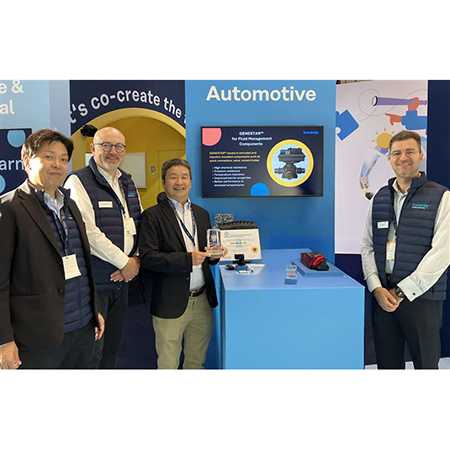
Kuraray Co., Ltd. (Headquarters: Chiyoda-ku, Tokyo; President: Hitoshi Kawahara) hereby announces that the coolant control valve (CCV) developed utilizing its heat-resistant polyamide resin GENESTAR™ has received the New Mobility Category Award at the SPE Automotive Award 2025, presented by the Society of Plastics Engineers (SPE). This CCV was jointly developed with Yinlun Co., Ltd., a major manufacturer of heat-exchange equipment in China.
1. Reason for Award / Product Overview
The SPE Automotive Awards recognize innovative plastic technologies in the automotive industry. The CCV, which was awarded third place in the New Mobility category, was recognized for its lightweight and compact design employing plastic instead of metal that contributes to improved fuel efficiency in new energy vehicles.
Thanks to the combination of two grades of glass fiber-reinforced GENESTAR™ with high laser transmittance characteristics and hydrolysis resistance, the valve also boasts the rigidity and fatigue resistance needed to withstand the dynamic loads critical in automotive applications.
Furthermore, as GENESTAR™ enable to attain multiple material processing steps such as bump-off molding* and laser welding, the efficiency of CCV production can be improved.
*A molding technique that allows efficient removal of parts from the mold, even when the product has undercuts (shapes that interfere with the mold’s opening direction), by temporarily deforming the part.
2. Contribution to Environmental Performance Improvement
Automotive thermal management systems incorporate multiple electric valves that optimally distribute coolant to components requiring temperature control, such as drive motors, batteries, and inverters, thereby enhancing the vehicle’s overall energy efficiency. As thermal management systems in new energy vehicles are becoming increasingly complex, technological innovation is essential for performance improvement.
The new CCV, which integrates Kuraray’s material design technology of GENESTAR™ with Yinlun’s product design technology, achieves weight reduction through the incorporation of electric valves and enhances cooling control precision. This is expected to yield an improvement in environmental and other performance, including significant reductions in CO₂ emissions for internal combustion engine vehicles and extended driving ranges for new energy vehicles.
Kuraray Wins SPE Automotive Award 2025
crop-comp267715.png "Kuraray Trosifol<sup>®</sup> SentryGlas<sup>®</sup>")
| T | +49 173 284 6719 |
|---|---|
| E | anton.novozhilov@kuraray.com |
| W | Visit Kuraray Trosifol® SentryGlas®'s website |
| Kuraray Europe GmbH, PVB Division, Muelheimer Str. 26, Gate 3 Building 362, Troisdorf, 53840, Germany |
Products by this Company


Categories
Document management Safety Security Surfacing