

After years of false starts, the future of augmented reality may depend not on chips or software, but on how light moves through glass.
Long before engineers chased the promise of digital overlays, Benjamin Franklin grappled with the problem of human vision. By 1784, having grown tired of fumbling between two pairs of spectacles to manage blurred near and far sight, the youthful 78-year-old searched for a solution.
While a few inventive opticians had experimented with more elaborate frames, Franklin’s answer was deceptively simple. He sliced the lenses from both pairs of glasses and combined them into a single frame. In a letter to his friend George Whatley, he wrote that he was “happy in the invention of double spectacles, which serving for distant objects as well as near ones, make my eyes as useful to me as ever they were.”
Those “double spectacles” would soon be known as bifocals, a creative tweak to glass lenses that changed the way people moved through the world. Centuries later, a unique rethinking of lens-making would again provide a breakthrough in human vision – but this time, for augmented reality.
The pioneer behind modern optics
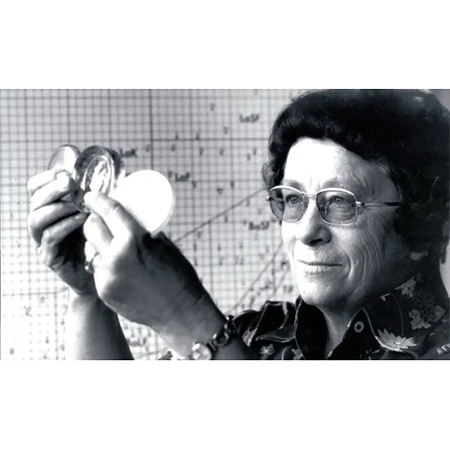
Nearly two centuries after Benjamin Franklin combined two pieces of glass to create bifocals, a German glass chemist named Marga Faulstich redefined what lenses could be made from in the first place.
Joining SCHOTT in 1935, Faulstich co-developed thin glass coatings that became foundational for sunglasses, anti-reflective optics, and modern façade materials. Over four decades, she rose to become SCHOTT’s first female executive and helped create more than 300 specialty glasses, including the lightweight corrective lens Schwerflint 64.
In many ways, her pioneering work in glass chemistry and optical performance paved the way for today’s AR waveguides.
Technology at the precipice
For decades, engineers have chased the dream of turning ordinary eyewear into intelligent companions: glasses that could layer digital information seamlessly onto the world around us.
Yet the technology long lingered at the edge of possibility. Even as microchips shrank and designs improved, augmented reality (AR) or mixed reality (MR) remained caught between promise and practicality. Early iterations were too clunky, power-hungry, or lacked the supply chain for mass production.
After years of prototypes and false starts, the breakthrough that could finally make smart glasses feel natural isn’t digital at all – it’s material.
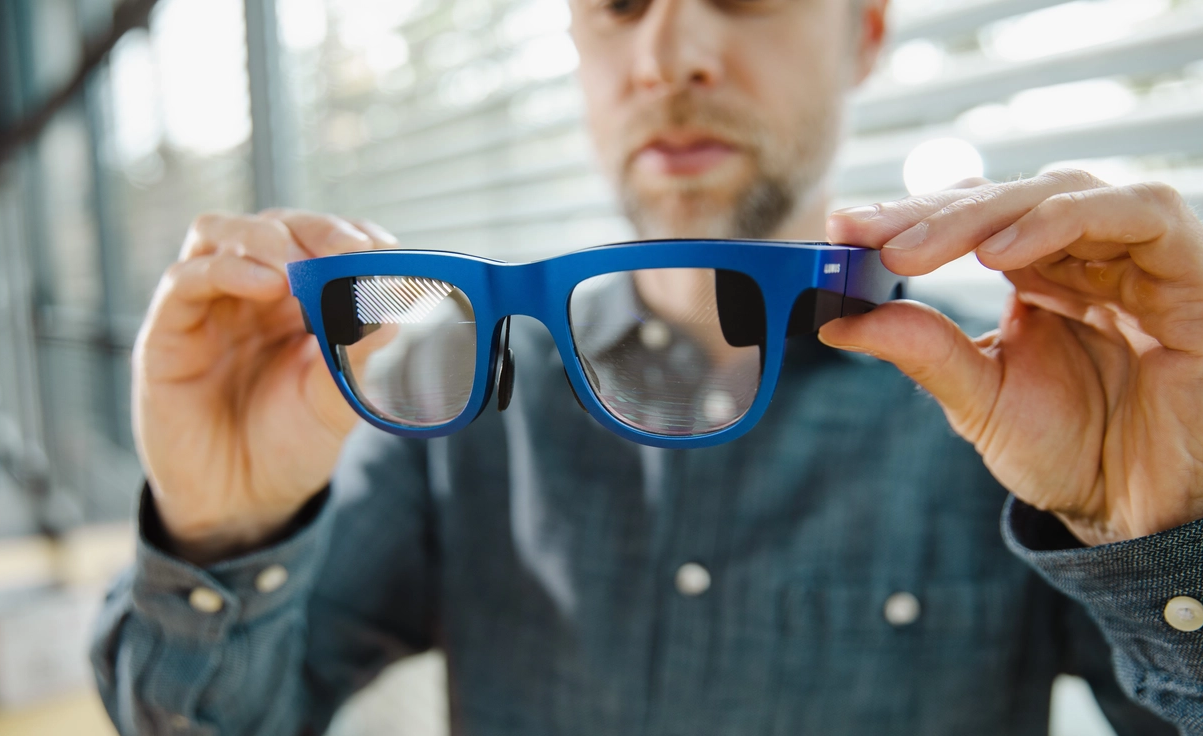
At first glance, the lenses above might look like ordinary pieces of glass. But embedded in the lens is a cascade of microscopic mirrors – each one precisely angled to guide light from a projector in the temple through the glass and into the wearer’s eye. The result is an image that appears to float naturally in space, seamlessly blending with the real world.
Historically, AR lenses – or waveguides – have relied on “diffraction” to project digital information into the user’s view. These “diffractive waveguides” rely on a system of nanostructures, called “gratings,” that direct light by bending and splitting it.
Another optical system directs light via controlled reflection, not diffraction. These mirror-based magical lenses are called geometric reflective waveguides. That distinction, says Dr. Ruediger Sprengard, Head of Augmented Reality at SCHOTT, is what sets reflective waveguides apart.
“Reflective waveguides maintain brightness and clarity while using less power,” he explains. “They enable the kind of immersive, all-day wearable experience the AR industry has been chasing.”
Read the full story
AR’s big breakthrough is hidden in the lens

| T | +44 (0) 3300 021340 |
|---|---|
| E | info.uk@schott.com |
| W | Visit SCHOTT UK's website |
| Wolverhampton Science Park, Glaisher Drive, Wolverhampton, WV10 9RU |
Products by this Company




Categories
Product Innovation