
-file170570.jpg)


Around 430,000 social and local authority-owned homes require upgrades to meet the Decent Homes Standard, meaning retrofit is no longer a consideration, but a must. It’s a challenge that encompasses meeting carbon targets, tackling fuel poverty and ensuring homes are safe and fit for residents. From a specification standpoint, however, the UK’s ageing social housing stock introduces a level of complexity that far outweighs that of typical residential projects.
This challenge shifts the role of the specifier when it comes to retrofitting specification. As these systems influence compliance and performance to ensure plumbing and heating systems are future-ready, disruption to residents is inevitable, making system selection essential to minimise the impact of upgrades for occupants.
Here, Lee Halstead, Technical Sales Engineer for RWC, details how specifiers can ensure their retrofit specifications support the transition of ageing social housing into efficient, low-carbon homes for residents.
Understanding the social housing challenge
Around four million homes sit within the UK’s social housing sector, with around 20% - more than 800,000 homes – falling below the EPC C standard. This leads to the strong implication that the drive for future-ready homes should be a retrofit problem – not just a new build one.
With the majority of today’s social housing built pre-1980, the UK’s social housing stock is ageing and was constructed to different standards – far below those of today. Their plumbing and heating systems were designed for completely different patterns of use, energy costs and more lenient regulations. And while these legacy systems remain functional, due to ageing pipework and the need to operate at higher temperatures, they are incompatible with the demands of low-temperature systems, water efficiency targets, and stricter regulations.
These factors can result in more efficient, cost-effective operation, potentially saving residents money on bills and maintenance callouts.
There are also the regulatory benefits of retrofit plumbing to consider. The updated Part L and Part G of the Building Regulations, introduced in 2025, have reshaped how heating, hot water and plumbing systems must operate in preparation for the 2028 Future Homes Standard. Under Part L, when replacing a boiler, the new system must be designed with a maximum flow temperature of 55°C (previously 75°C) to improve efficiency, and it necessitates better heating controls, such as smart thermostats, when a new boiler is installed.
Similarly, under Part G, where a hot water system is replaced, the new system must be designed to work efficiently at lower temperatures, both to complement Part L and aid future heat pump adoption. While these changes lead to higher upfront costs for building owners, in the long term, occupants will experience lower energy bills, improved comfort and reduced carbon footprint.
Designing for occupied homes
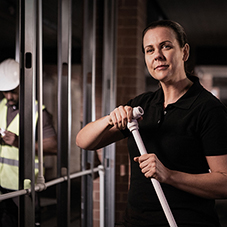
A defining feature of social housing retrofit is how work is typically carried out while residents are in the property. For specifiers, this, alongside working with legacy heating systems, creates a fundamentally different challenge to new build projects. Not only do they need to work within existing constraints, but they must also design systems that can integrate with dated infrastructure and limit invasive works such as floor removal or extensive pipe rerouting.
To overcome these challenges, if existing social housing stock is to become future-ready, low-profile retrofit solutions will be essential to aligning legacy systems with the performance, efficiency and compliance requirements of modern homes.
One area where this is most evident is in heat source selection. With a growing, targeted rollout of low-carbon heating alternatives in the UK and Europe, low-carbon heat sources such as heat pumps are anticipated to become the default heating system due to their significantly lower flow temperatures than traditional boilers.
This has a direct link to system design for specifiers as it fundamentally changes how heat emitters and heat distribution networks are designed, placing increased importance on specifying appropriate pipework and ensuring system layouts are optimised for performance and efficiency.
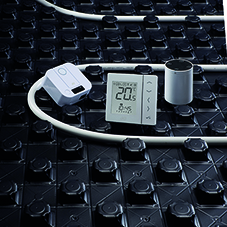
As heat pump adoption grows, there will be a corresponding market shift towards heat emitters that can deliver comfort at lower temperatures. Already one of the fastest-growing sectors of home heating, underfloor heating (UFH) perfectly aligns. Offering large surface areas, flow temperatures below 55°C and consistent heat output that supports efficient system operation, it is an ideal match for heat pumps.
Advances in retrofit-specific UFH systems mean that they can be leveraged on retrofit projects without the need to rip up the floor. Low-profile solutions such as JG Lowfit from JG Underfloor offer low-profile UFH panelling solutions for timber and screed floor applications ranging from 16-20mm. This enables specifiers to reduce installation complexity and limit disruption for residents, something which is a key consideration in retrofit scenarios.
Safety and compliance
With social housing often occupied by vulnerable individuals and young children, safety is another element that needs to be considered by specifiers. When factors such as flow and pressure are managed effectively within a system, pipes and fittings are under less pressure and can last longer, and water usage can be managed more effectively to reduce consumption and ensure safe operation.
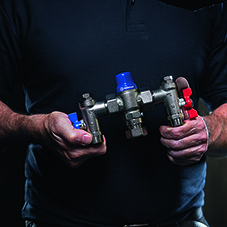
To control these factors, water control valves are integral. Pressure Reducing Valves (PRVs) can be installed during retrofit works to manage water pressure throughout the system, potentially reducing strain on legacy pipework. In practice, a PRV will help to protect a system for the long-term, support the management of consumption, and even encourage effective water metering, which is especially important in buildings with more than one dwelling.
Looking towards temperature control, Thermostatic Mixing Valves (TMVs) can be fitted ahead of outlets to blend hot and cold water and ensure safe delivery temperatures and reduce the risk of scalding.
Higher flow rates, often caused by high pressure levels, can also cause increased water consumption during activities such as showering or running taps. To avoid this, Thermal Balancing Valves (TBVs) automatically regulate flow rates in hot water recirculation systems based on water temperature, ensuring consistent, energy-efficient, and balanced temperatures at all fixtures.
As well as improving safety, these valves can also lead to greater system efficiency and make systems fit for the future.
Supporting successful retrofit
Manufacturers such as RWC and its family of brands, including JG Underfloor and Reliance Valves, support specifiers undertaking retrofit projects. With decades of expertise in creating solutions that underpin efficient performance and compliance, their broad range of purpose-designed retrofit solutions caters to the needs of individual projects, helping specifiers meet every design need with fast and reliable installations.
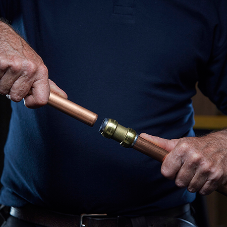
This includes low-profile UFH systems, innovative valve technologies and flexible pipework solutions. Together, these products can ensure long-term reliability and compliance, bridging the gap between design and on-site reality.
To learn more, visit https://www.reliancevalves.com/gb/en.
Retrofit-ready: Upgrading social housing for a low-carbon future
 (002)-comp104848.png "RWC – Reliance Worldwide Corporation")
| T | (01895) 425333 |
|---|---|
| E | Info@RWC.com |
| W | Visit RWC – Reliance Worldwide Corporation's website |
| Horton Road, West Drayton, Middlesex, UB7 8JL |
-file170568.jpg)
crop-file170568.jpg)
crop-file170570.jpg)