What Standards Must a Thermostatic Mixing Valve Meet for Use in NHS Facilities?
Thermostatic mixing valves (TMVs) used in NHS facilities need to meet the TMV3 approval scheme and the NHS D08 standard. Together, they give assurance that a valve has been tested and deemed safe to use in an NHS setting, where water is stored hot enough to thermally disinfect the system.
In Part 2 (link to Part 2 once live), we looked at how TMVs reduce the scalding risk at the outlet. Here, we look at the standard those valves need to meet in healthcare premises, what it covers and what manufacturers must show to achieve it.
Why Healthcare Facilities Need TMV3 / D08 Valves
To control Legionella, healthcare water is stored and distributed at temperatures high enough to thermally disinfect the system. When water is stored this hot, the TMV specified at the outlet must adhere to the strict testing regime of TMV3 / NHS D08.
What Is TMV3 Approval?
The TMV3 approval scheme gives assurance that a thermostatic mixing valve has been tested and deemed safe to use in an NHS setting. It applies to TMVs used in high-risk commercial healthcare applications within the UK.
TMV3 valves offer a high level of protection. They react much more quickly to shut off the flow of water if the cold supply fails, or if a safe temperature is exceeded.
(NSF TMV3 certification logo, p6)
What Is NHS D08?
D08 is the NHS performance specification for thermostatic mixing valves in healthcare premises, published as a supplement to HTM 04-01. Testing bodies must ensure that a TMV3 valve adheres to it.
D08 ensures a stable temperature output despite varying supply pressures and temperatures, so the valve keeps delivering water at a safe temperature as conditions in the system change.
Our guide to TMV regulations sets out the wider British and European standards that apply to TMVs, along with the D08 service schedule.
What Do Manufacturers Need for TMV3 Accreditation?
Alongside performance testing, other important factors are taken into consideration for TMV3 accreditation:
● Quality management – The company or manufacturer applying for accreditation must prove compliance with ISO 9001, or an equivalent quality management system.
● Markings – The valve must carry the correct markings, so it can be identified in the field.
● Documentation – The installation and maintenance documents must include the information stated by the scheme.
Once installed, a TMV also needs regular checks to keep giving its intended protection, which we cover in Part 4 (link to Part 4 once live).
Is TMV3 the Only UK TMV Approval?
No. TMV2 is the other UK approval, and Part 7 (link to Part 7 once live) explains how the two differ. Our guide to TMV2 and TMV3 covers both schemes in more detail, and Altecnic’s thermostatic mixing valve range includes valves accredited to both.
This content was originally published in IDRONICS UK Issue 2 in September 2021.
Adapted from an editorial by Stephanie Allchurch, Product Development Manager at Altecnic.
How does a TMV3 valve react if the cold water supply fails?
TMV3 valves react much more quickly to shut off the flow of water if the cold supply fails, or if a safe temperature is exceeded. This gives a high level of protection against scalding.
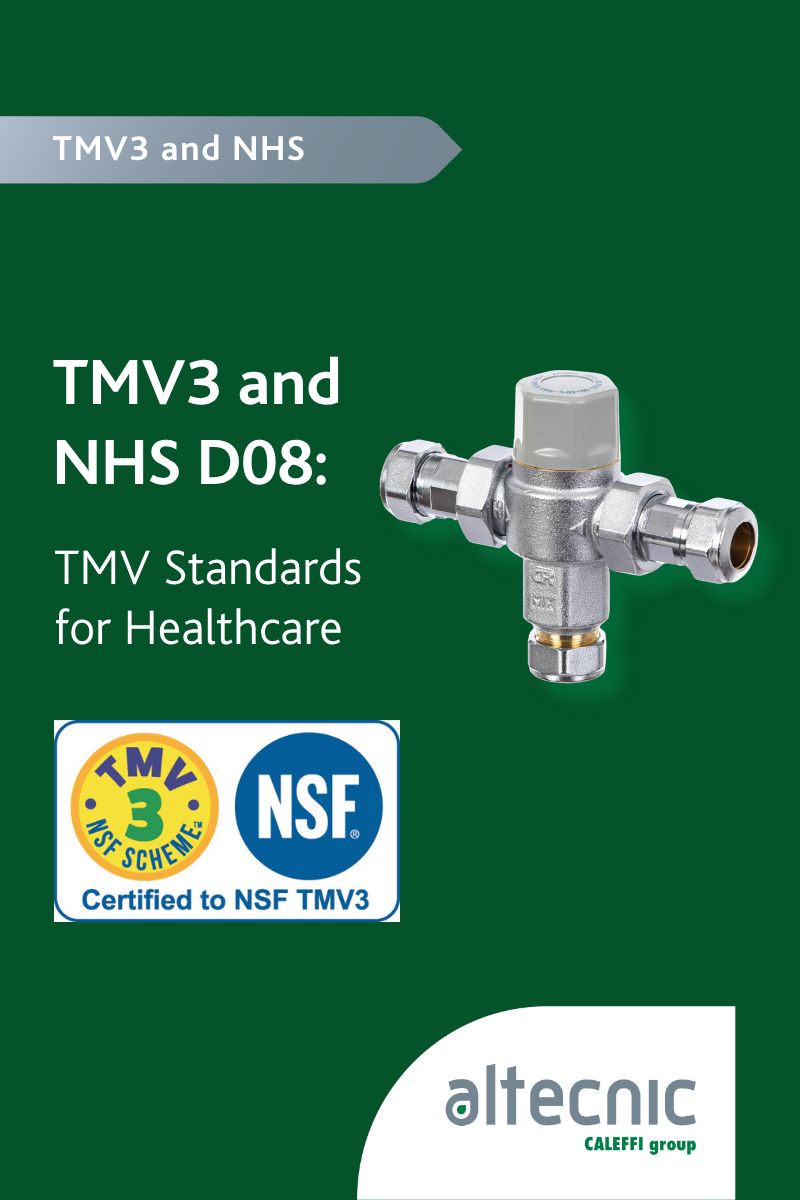
TMV3 and NHS D08: TMV Standards for Healthcare

| T | (01785) 218200 |
|---|---|
| F | (01785) 218201 |
| E | barbour@altecnic.co.uk |
| W | Visit Altecnic Ltd – Caleffi Group's website |
| Francesco House, Staples Cl, Stafford, ST16 1WQ |


Categories
Prefabricated plumbing units Valves